The Benefits of Reading to Your Baby in the womb
By Megan McCoy Dellecese (repost)
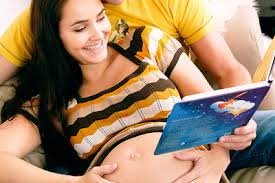
You may think the only benefits of reading to your unborn baby are the relaxation and bonding you feel. But science shows that reading to baby in the womb helps develop early language learning.
Maybe talking, singing, or playing music to a baby while in the womb comes naturally to many expecting couples. There’s much to be said for reading to a child in utero. There are numerous advantages—both for baby and the parents.
Parent-Baby Bonding and Lower Maternal Stress
Many studies show that reading (particularly from the mother’s relaxing voice) causes a baby’s fetal heart rate to lower. Also, the bond that is experienced between parent and child later on can start to occur while Mama or Papa read to the baby prenatally. It’s also a great way to kickstart a secure attachment in infants.
Participation in reading is also a great way for other family members to connect with the baby. An older child can read or talk about her favorite parts of the story. And the new baby can start to learn his sibling’s voice.
We can be very focused on the preparation for the coming of new life and the general health needs of the mother and baby. However, early attention through reading to your unborn baby builds a wonderful foundation to solid future relationships.
Reading to your unborn baby also helps you slow down, relax, and experience the fun moments of early parenting. You’ll enjoy the sweetness and simple lessons (which can be great at grounding adults in times of stress) of a good picture book.
Will reading to your baby in the womb make her smarter?
Legend has it that cellist Pablo Casals started to sight-read a piece of music and soon realized he knew what was coming next, without reading it. He later learned that his cellist mother had rehearsed the piece daily in the later stages of her pregnancy.
Talking, reading, and playing a variety of music can help stimulate baby’s senses and improve her brain development, according to Dr. Michael Roizen. “Exposure to different sounds and scenes is essentially what helps establish connections from one set of neurons—the nerve cells of the brain—to another. This is how we all learn.”
A study at the University of Oregon found when pregnant mothers were given a recording that included a made-up word to play near the end of pregnancy, the babies were able to recognize the word and its variations after they were born. They could discern this by neural signals emitted by the babies that showed they recognized the pitch and vowel changes in the fake word. The babies who heard the recording most frequently displayed the strongest response, suggesting that infant language learning begins in utero.
When should you start reading to your baby in the womb?
At about six months along, a baby is already quite familiar with the sounds of the womb, from the mother’s heartbeat to digestive sounds. From outside the womb, sounds are extremely clear, although about 10 decibels lower.
From Week 25 forward, a baby’s primary connection and information to the outside world comes in the form of sound. By this point, the soothing, rhythmic sounds of a simple story should be quite audible, although the tones and cadences of the voice are more important than enunciation of the actual words.
Born2care questionnaire:
Please complete the questions to earn 100 points and exchange at the Born2Care Vereeniging baby shop through learn-&-earn.